QRQC in one paragraph
QRQC stands for Quick Response Quality Control. It is a problem-solving method in which every defect is treated as soon as it is detected, by the people closest to it, at the place where it happened. The team secures the customer first, then looks for the root cause with facts rather than opinions, puts corrective actions in place and records what it has learned so the whole organization benefits.
QRQC is not a one-off workshop: it is a daily management rhythm, usually a short stand-up meeting at the line, then at the workshop and plant levels, where open problems are reviewed against their deadlines.
Where QRQC comes from
QRQC was developed in the Japanese automotive industry at Nissan and spread across European car makers and their suppliers in the 2000s, notably through the Renault–Nissan alliance. It has since become a standard practice at many automotive suppliers and, more broadly, in aerospace, rail, electronics and other discrete manufacturing industries.
Its success comes from its simplicity: a few strict rules, a fixed rhythm and a small set of tools that everyone on the shop floor can use.
The three “real” principles (San Gen Shugi)
QRQC is built on the Japanese principle of San Gen Shugi — the three reals:
- Genba — the real place
- Go to the workstation, machine or warehouse where the defect happened instead of discussing it in a meeting room.
- Genbutsu — the real thing
- Look at the actual defective part next to a good part, rather than at a description or a photo from memory.
- Genjitsu — the real facts
- Collect data — quantities, times, batches, measurements — before drawing any conclusion.
The QRQC cycle: detect, communicate, analyze, verify
Every QRQC incident goes through the same four moves, followed by capitalization:
- Detect
- Spot the defect as early as possible and describe it precisely, typically with 5W2H: what, where, when, who, how, how many — and why it is a problem.
- Communicate
- Alert the right people immediately and launch containment: stop, sort, protect the customer. A quality alert makes the problem visible to every shift.
- Analyze
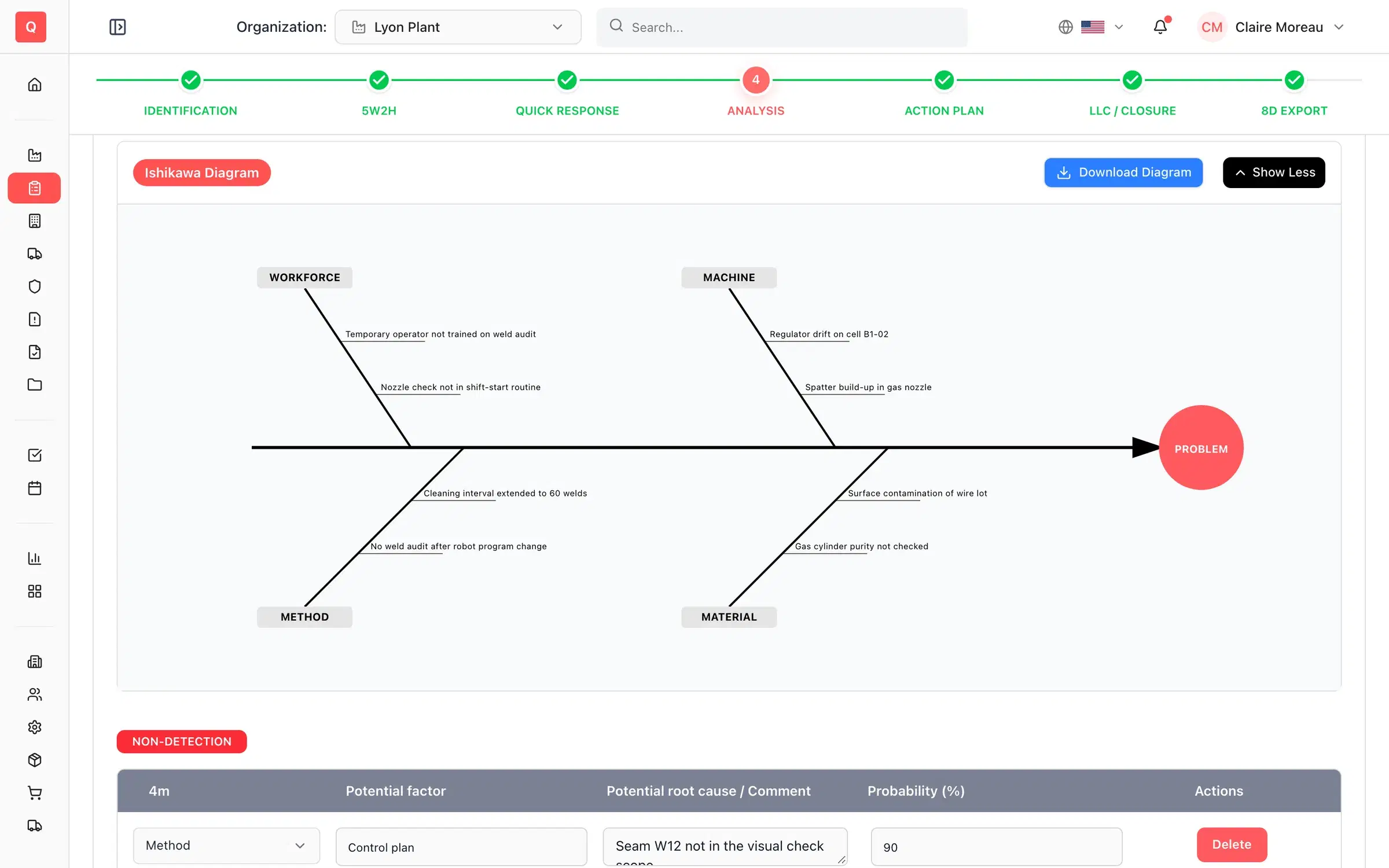
- Find the root cause of both the occurrence and the non-detection, with tools such as 5-Why, the Ishikawa (5M) diagram or a fault tree.
- Verify
- Implement corrective and preventive actions, then check on the shop floor that they work and that the defect does not come back.
- Capitalize
- Record the lesson learned (often as an LLC — lessons learned card), update standards and roll the fix out to similar lines and products.
The three levels: line, APU and plant
QRQC runs at several levels with a clear escalation path. At line level, the team leader handles problems that can be solved locally, often in a short 5-step format. When a problem needs more resources or crosses several lines, it is escalated to the APU (autonomous production unit, UAP in French) or workshop level. Customer claims and major issues are handled at plant level, where management reviews the most critical topics every day.
Each level has its own daily meeting and its own list of open problems — which is exactly why paper and spreadsheets break down as soon as a site grows.
The 24 hours / 10 days / 30 days rhythm
A common rhythm in automotive QRQC is: containment within 24 hours so the customer is protected, root-cause analysis within 10 days, and corrective actions implemented and verified within 30 days. Following these three deadlines on every incident — and reviewing late ones in the daily meeting — is what keeps QRQC quick.
Tools used in QRQC
- 5W2H
- A structured description of the problem so that everyone works on the same facts.
- 5-Why
- Asking “why?” repeatedly until reaching a cause you can act on — separately for why it happened and why it was not detected.
- Ishikawa (5M)
- A fishbone diagram exploring Man, Machine, Method, Material and Milieu (environment).
- Fault tree analysis
- A top-down breakdown of the combinations of events that can lead to the failure.
- PDCA
- Plan, Do, Check, Act — the improvement loop behind every action plan.
- SQCDP
- A daily board following Safety, Quality, Cost, Delivery and People, often used in the same meeting as QRQC.
QRQC vs 8D
QRQC and 8D are complementary. QRQC is the fast, daily reaction routine used for every defect. The 8D (eight disciplines) is a structured problem-solving report, often required by customers for claims: team, problem description, containment, root cause, corrective actions, validation, prevention and congratulations.
A well-run QRQC already contains most of the 8D: the 5W2H is the problem description, containment is D3, the 5-Why and Ishikawa feed D4, the action plan covers D5 to D7 and the lessons learned close the loop. That is why a digital QRQC can generate the 8D report directly from the incident.
Why digitize QRQC?
The QRQC method is simple; the administration around it is not. With one spreadsheet per line and per week, containment chased in chat groups and 8D reports rebuilt by hand, teams spend their time on paperwork instead of the shop floor.
A digital QRQC keeps one live record per incident, follows the 24h/10d/30d deadlines automatically, escalates from line to plant in one click, brings suppliers into the loop and turns every incident into KPIs, SQCDP boards and 8D reports without extra work.